
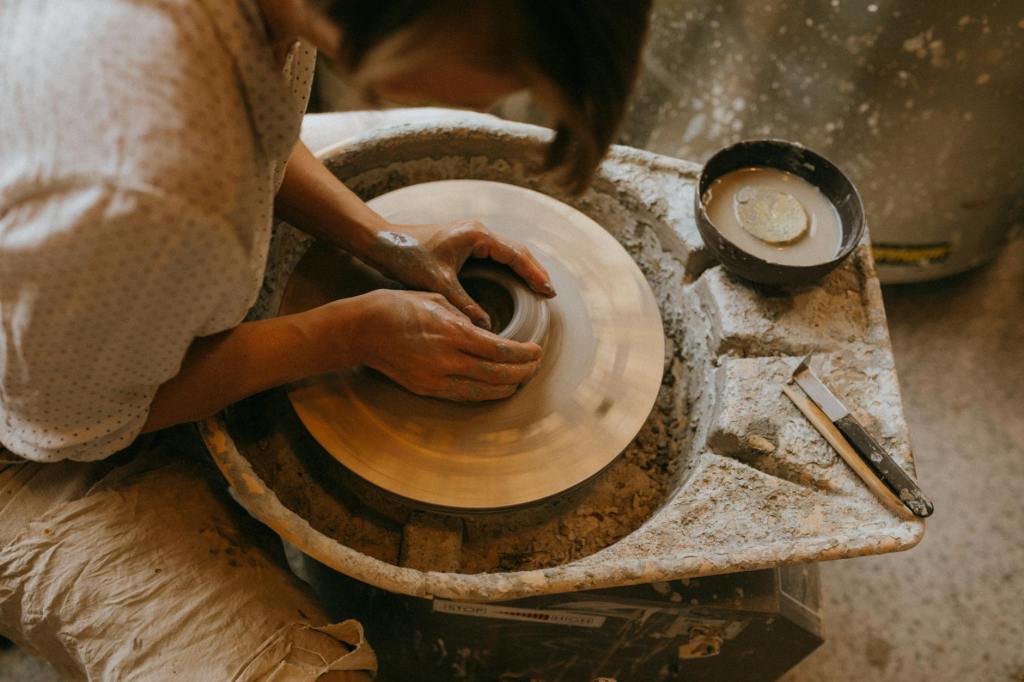
There’s a tension many of us carry as creatives—quiet, persistent, and often unspoken.
On one side is the artist: intuitive, untamed, guided by feeling, willing to break the rules for the sake of meaning.
On the other is the craftsman: disciplined, precise, focused on mastery, structure, and doing things well.
For a long time, I didn’t understand the craftsman at all.
In art school, I fully identified as an artist. I trusted instinct, emotion, and imagination. But when it came to craft—things like color theory, visual grammar, or spatial logic—I found it stifling. At best, it felt mechanical. At worst, it felt like an attempt to control something that was supposed to be free.
But that shifted when I started learning the psychology behind it.
Once I realized that craft wasn’t about restriction—it was about communication—I dove in. I began studying how artists use structure not to suppress emotion, but to guide it. I found so much joy in dissecting how those elements—shape, rhythm, contrast, space—could influence how someone feels when they see a frame or hear a phrase. It was like learning a language I didn’t know I’d been speaking all along.
Now, I don’t see artist and craftsman as opposites. I see them as collaborators.
Structure Isn’t the Enemy of Soul
When I wrote about The 7 Habits of Highly Effective People, I talked about systems that protect creativity rather than restrict it. That same idea lives here, too.
The more I’ve worked in animation and production, the more I’ve come to respect the craftsman mindset. It’s not about rigidity—it’s about intention. It’s about honoring the work enough to shape it carefully, instead of relying on last-minute inspiration to pull everything together.
Craft makes art repeatable. It builds trust. It gives you the freedom to play because the foundation is solid.
And artistry makes craft alive. It keeps the work from becoming mechanical, predictable, or emotionally flat. Without the artist’s perspective, we lose the why.
A Lesson From My Thesis
When I was finishing my thesis, one of my professors challenged me with something I’ve never forgotten.
At the time, I was researching how to calm and heal the body through sound, color, and movement. I was fascinated by softness—what soothed us, what made us feel safe. But he asked me: “If you want to truly understand what calms the body, shouldn’t you also study what stresses it?”
It stopped me. He was right. I had been avoiding discomfort, thinking I could get to peace by skipping over pain. But understanding both was the real path to clarity.
That conversation taught me something much bigger than the thesis itself. That contrast is essential. Light needs shadow. Flow needs friction. And artistry needs craftsmanship—not as an opposite, but as a mirror.
Creative Reflection: Your Artist / Craftsman Balance
If you’d like to explore where you lean—and what might be asking for more space—try this quiet exercise. No right answers. Just notice what rings true.
Step 1: Gut Check
Which one do you identify with more right now?
- The Artist in me craves:
→ Emotion • Wonder • Expression • Intuition
→ I feel most alive when… - The Craftsman in me values:
→ Structure • Skill • Precision • Practice
→ I feel most steady when…
Step 2: The One You Hide
Ask yourself gently:
Which side of me feels undernourished—or quietly dismissed?
Is there a time I chose one and silenced the other?
Step 3: What Needs Attention?
Complete the sentence:
This week, I’d like to make space for more ______.
→ A playful spark? A focused rhythm? A deeper blend of both?
Sometimes the best work comes not from choosing—but from listening to both voices at the table.
What If We Stopped Choosing?
What if we stopped asking, “Am I a craftsman or an artist?”
And started asking, “What does this work need from me right now?”
Because craft without feeling is cold.
And art without structure can lose its way.
But when we hold space for both—
when we let instinct guide the heart of the work
and let discipline shape its form—
we create something else entirely.
We create work that lasts.
Work that moves.
Work that knows what it is.
Not just impressive.
Not just expressive.
But true.
If you’re exploring how emotional authenticity shapes creative work, you might also enjoy Invisible Thread — a reflection on how emotional truth connects us more deeply to the stories we tell.
 Christy Heyob | Building Worlds, Stories & Creative Teams
Leave a comment